Posts

Quadrature of the Lune

Image
I decided to talk about Leonardo de Vinci in this blog because his art is amazing, and most of his sketches were influenced by mathematical ideas. Some of his sketches were influenced by the Quadrature of the Lune.  In the context of Leonardo da Vinci, the lunes are interesting because Leonardo often used them in his designs of ornaments, and in the failed (of course) mathematical attempts of quadrature of the circle. R epresented below is one of his numerous designs  related to a combination of polygons and circles  in the "modern". The image below is known as Leonardo's claw.
Transformations in Animations

Image
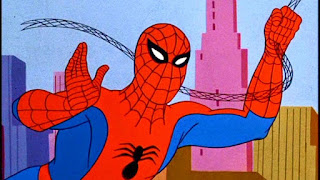
All animations are made up of a series of different types of transformations. If an animator wants to move a character or object left/right or up/down all they have to do is reflect the object/character in respect to the x-axis or y-axis. An example of rotations and dilations is in animation is in the Spider-Man animated series.  In the cartoon, as he is flying, he rotates a certain number of degrees through the air. Then if he is going away from the camera he dilates a negative amount.

Hypercube, Tesseract

Image
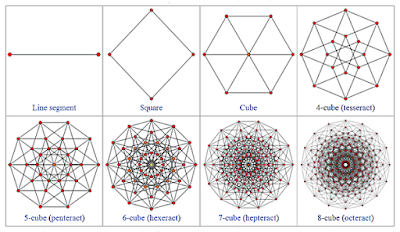
A tesseract is the 4-dimension of a cube and a hypercube is the n-dimension of a cube. A tesseract is to a cube as a cube is to a square. We will never know internally what a tesseract looks like because we are in the third dimension. To create a cube, you move a square one unit length perpendicular to the plane it lies on, and by doing this you create a three-dimensional cube. Then to create a tesseract, you move the cube one unit length into the fourth-dimension. Charles Howard Hinton was the first to coin the word tesseract, in 1888 in his book A New Era of Thought . After watching many videos and reading a couple of articles, I have to say that tesseracts and hypercubes are such a hard concept to fully understand. I have a simple understanding of what a tesseract is, and how to create a tesseract. But at the same time, it is hard to fully grasp the complete idea of a tesseract. Cause it does not just stop at a tesseract, there is an infinite number of dimensions, which mea...

Trigonometry: Pitch of Roof

Image
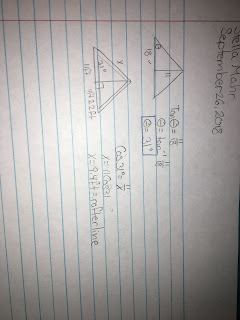
The pitch of a roof is equivalent to the hypotenuse of a triangle. The 11/18 in an 11/18 pitch, is the slope of the pitch, and we know that the slope is the rise of the run. With the knowledge that the slope is rise/run, we can deduce that the two legs are 11 and 18, with 11 being the rise and 18 being the run. Then from there, it is quite simple to find the angle of elevation. To find the angle of elevation you first set up the tangent equation: Tan A=11/18. Then you multiply each side by the inverse tangent: A= tan^-1 (11/18). Then you will get that the angle A is equal to 31 degrees. Next, we had to find the "rafter line" if the full length of the "run" is 22ft. This was pretty easy to figure out, first, I had to set up the equation: Cos31=11/x. I chose to use the Cos equation because we were trying to find the length of the rafter which is equivalent to the hypotenuse of a triangle, and we were given the adjacent leg. Next, we simply solved the equation: x=Cos...

Trigonometry: Grade of a Road

Image
The grade of a road is the tangent of the angle of that surface to the horizontal. If the grade is 0% then there is no slope, but the greater the % the higher/steeper the degree of tilt is. Knowing the grade of a road is important for cars because they have something called the gradeability. The gradeability of a car is the highest grade a car can go at a certain speed. So if the grade is high the driver then knows that they have to go a greater speed to prepare for the steep hill. The grade of a road is equal to the slope of a line. Also, the grade of a road is equivalent to the hypotenuse of a triangle, so if we can use trigonometry to find the hypotenuse we can use trigonometry to find the grade of a road.

Fractals

Fractals were discovered in 1975 by a Polish man by the name of Benoît Mandelbrot, and when I say discovered I mean finally put into words. Benoît Mandelbrot defined a fractal as a geometric shape that when split into smaller parts, those parts would be exact replicas of the first shape. The word fractal comes from the Latin word fractus which means "broken" or "fractured". The idea of fractals had been around for a very long time before Benoît Mandelbrot, but he was the first to actually realize how amazing they were. Mandelbrot's first started researching how fractals can be found in nature. His first report was about how long the coast of Britain actually was. Before Benoît Mandelbrot, many mathematicians and philosophers had studied the idea of recursive self-similarity. But it wasn't until Mandelbrot solidified hundreds of years of thought and mathematical development and created the term fractal. After Mandelbrot, in 1980, an American by the name of Lo...

Err in the Direction of Kindness

I would consider myself a pretty shy person, I don't really talk to people who are not my friends and to be completely honest I don't really do well in social interactions. I prefer to sit in the back of the classroom, a habit that teachers don't really like. People like to interpret these qualities as being closed off and I guess in a way mean, but that is not how I want to be remembered. Being openly kind to someone who I don’t know is something that I struggle with because I am always too scared about what other people are going to think. People tend to care too much about what other people think about them, and I think that this has made us who we are today. We are people who will respond to someone’s suffering timidly and not do anything to help him or her. I think we all need to learn that we are slowly separating ourselves from one another just because we are afraid of what others might say. As we get older we stop caring about what other ...